
The king who is said to have received a supernatural message before battle — and would go on to become the first king of England
By Aelius Varro
Before entering history as the first king of England, Æthelstan was already surrounded by accounts of faith, war, and a possible omen that still feeds his most mysterious side to this day.
+ Who was Gualdim Pais? The figure who forever changed the history of the Templars in Portugal
+ In Tomar, the legacy of the Templars still wraps its streets and stones in an aura of mystery
Long before he was remembered as the man who became the first king of England, Æthelstan already appeared wrapped in stories that went beyond politics and battles. Among them, an ancient medieval legend still draws attention for its almost supernatural tone.
According to tradition, on the eve of one of the most decisive confrontations of his life, Æthelstan is said to have sought spiritual protection in a sacred place linked to Saint John of Beverley. It was a moment of total tension. Enemies threatened his power, the future of the territory was at stake, and any defeat could have changed the course of history.
It was in this setting that the most enigmatic account associated with the king emerged.
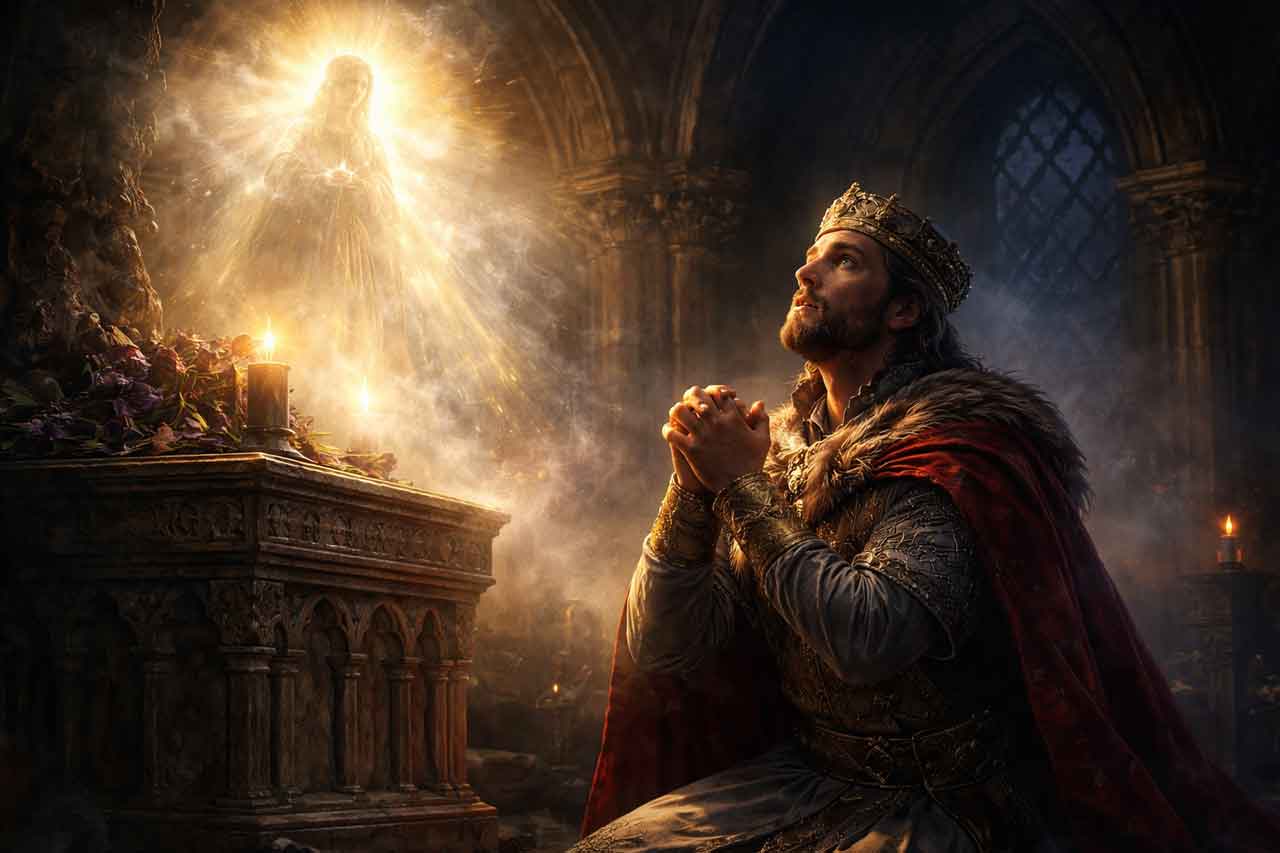
The legend says that, during the night, Æthelstan received a vision, a dream, or a mysterious sign. The message was clear: move forward without retreating, because victory would come. To the medieval mind, this was not merely a symbolic detail. Signs like these could be interpreted as proof that a ruler was being guided by divine forces.
When victory came, the story gained even more strength. The triumph came to be seen not only as a military feat, but as something marked by spiritual intervention. And it was precisely this image of a king protected by a greater destiny that helped expand the legendary aura surrounding Æthelstan.
Over time, he would be recognized as the first king of England, a central figure in the process of unifying the kingdom. But alongside his historical importance, the more mysterious version also survived: that of a sovereign who may have received an inexplicable warning before facing war.
It is this mixture of history and legend that keeps Æthelstan’s name so fascinating centuries later. Because what remained around him was not only the memory of a victorious king, but also the image of a man who is said to have heard destiny before changing England forever.
