
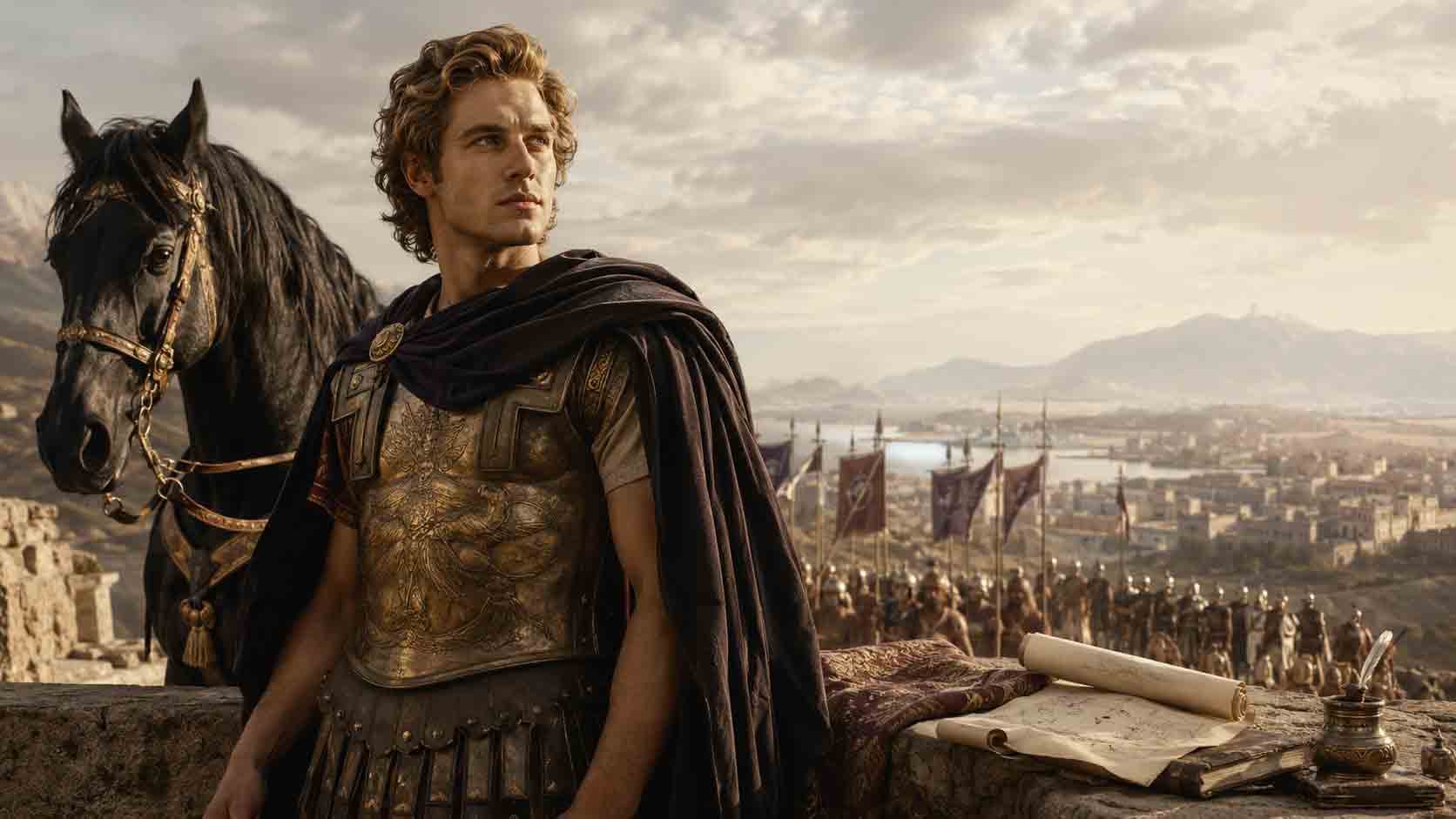
Alexander the Great went down in history as one of the greatest conquerors of Antiquity, responsible for forming an empire that stretched from Greece to Egypt and as far as the borders of India. But beyond the famous battles and the image of a young military genius, his life was also marked by curious episodes, unusual decisions, and lesser-known details.
By Aelius Varro
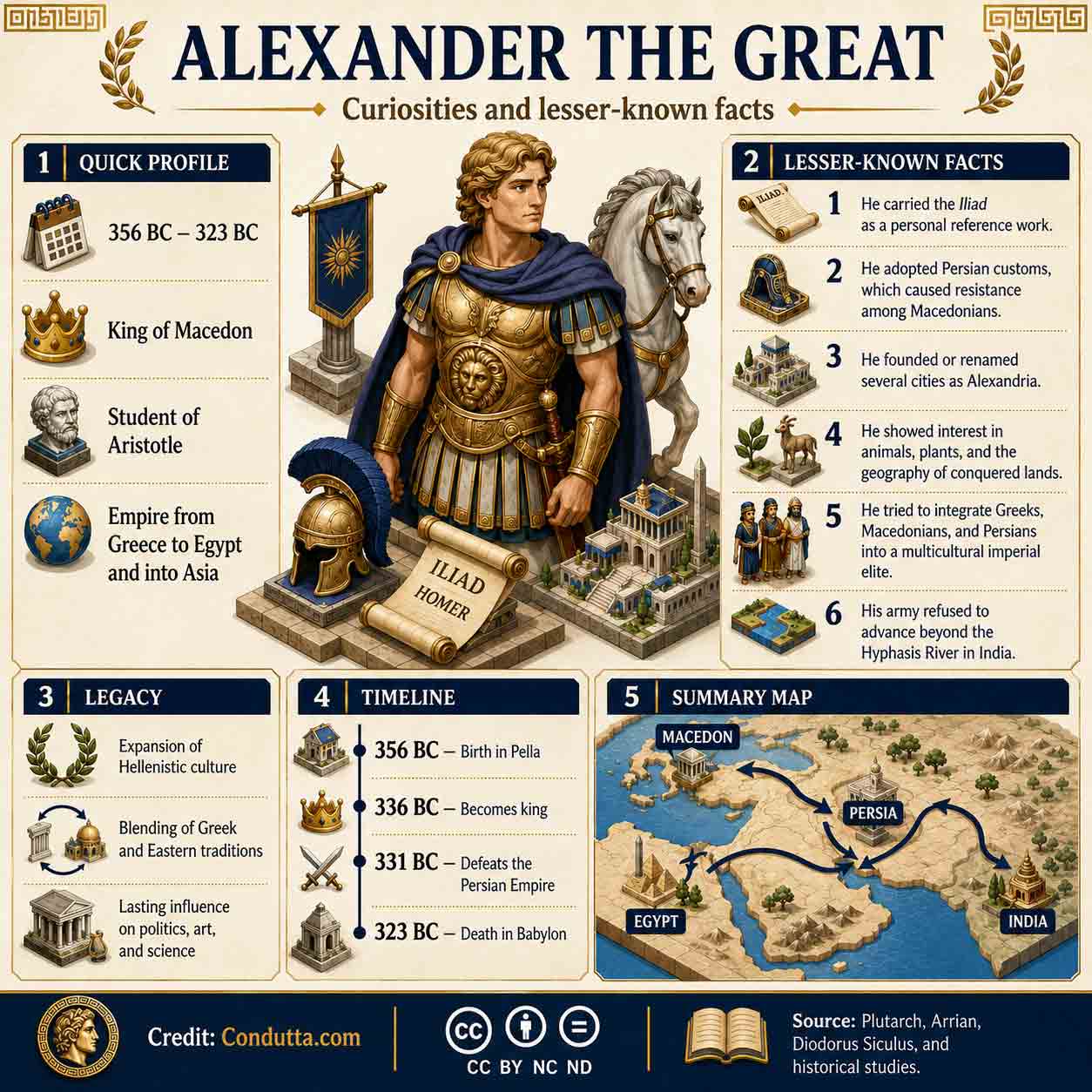
One of the most interesting curiosities is that Alexander was not only a warrior trained for combat. He was educated by Aristotle, one of the greatest philosophers in history, and studied subjects such as politics, medicine, poetry, ethics, and natural sciences. This education helped shape his worldview and influenced his attempt to unite different cultures within the empire.
Another lesser-known detail is that Alexander carried with him a copy of the Iliad, attributed to Homer. According to ancient traditions, he deeply admired Achilles and saw the Greek hero as a model of courage and glory. This symbolic relationship with literature helped build the image Alexander wanted to leave for posterity.
Although he is remembered as the king of Macedon, Alexander sought to adopt the customs of conquered peoples, especially after reaching Persia. He began wearing elements of Persian clothing and tried to bring Macedonian and Persian nobles closer together through political alliances and marriages. This attitude, however, irritated some of his own officers, who saw the change as a threat to Macedonian traditions.
A lesser-known curiosity involves his concern with founding cities. Alexander is believed to have founded or renamed several cities Alexandria, the most famous being Alexandria in Egypt. These cities were not merely personal monuments: they served as administrative, commercial, and cultural centers used to consolidate Macedonian rule in distant regions.
Another curious point is that Alexander showed great interest in exotic animals and in the nature of the territories he crossed. During his campaigns, plants, animals, and geographical information were observed and sent to Greek scholars. In this way, his conquests also expanded the Mediterranean world’s knowledge of Asia and the East.
Alexander’s relationship with his horse Bucephalus is one of the best-known stories, but there is an interesting detail: when the animal died, Alexander founded a city in his honor, called Bucephala, in the region of present-day Pakistan. The gesture shows the symbolic importance of the horse in the king’s military and personal life.
Another less-discussed fact is that Alexander faced growing resistance within his own army. After years of campaigns, his soldiers were exhausted and refused to continue advancing eastward, especially after reaching the region of the Hyphasis River in India. Even though he was an extremely respected leader, Alexander was forced to retreat under pressure from his men.
Another curiosity is that he tried to create a multicultural military elite. Alexander incorporated Persian soldiers into his forces and trained local youths according to the Macedonian model. The idea was to form a more integrated empire, but many Macedonian veterans interpreted this policy as a loss of prestige.
His death at the age of 32 remains surrounded by debate. Ancient explanations range from illness and fever to complications after banquets and theories of poisoning. What is known is that his sudden death triggered a major succession crisis, since Alexander did not leave an adult heir capable of keeping the empire united.
One of the less-remembered consequences of his trajectory was the expansion of Hellenistic culture. After his death, the conquered territories began to blend Greek, Egyptian, Persian, Mesopotamian, and Asian elements. This cultural fusion influenced art, religion, science, architecture, and politics for centuries.
Alexander the Great was not merely a commander of fast and decisive battles. He was also a figure of historical transition, responsible for bringing previously separate worlds closer together and for profoundly transforming the relationship between the Mediterranean, the Middle East, and Central Asia.
Sources: Plutarch, Arrian, Diodorus Siculus, and historical studies. Illustrations: Condutta.com
