
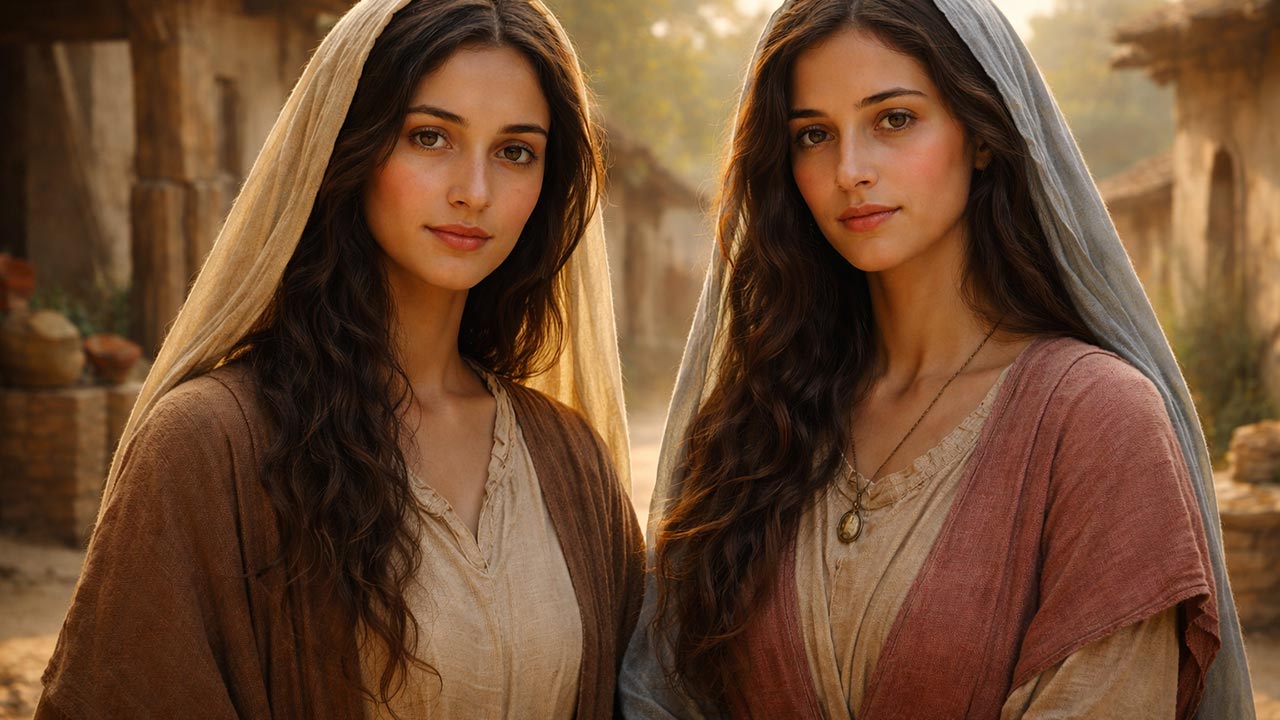
For centuries, the figure of Jesus of Nazareth has stood at the center of Christian tradition, while the names around him have been preserved, debated, and reinterpreted by different religious currents. But one ancient question remains shrouded in mystery: who were the sisters of Jesus briefly mentioned in the Gospels?
By Aelius Varro
The canonical texts do not reveal their names. They merely indicate that Jesus had sisters, without saying how many there were, how they lived, or what role they may have played in the life of the family.
That silence has fueled, over the centuries, a series of parallel traditions, apocryphal narratives, and speculations that sought to fill the gaps left by the Bible.
In some of these ancient traditions, two names emerge with force: Mary and Salome.
According to accounts preserved in Eastern Christian currents and in texts of an apocryphal nature, Mary and Salome were remembered as sisters of Jesus, discreet figures almost erased by official history. In these versions, they appear as part of the domestic world of Nazareth, sharing the simple routine of a Jewish family in Galilee, long before the name of Jesus echoed beyond the small villages of the region.
The most intriguing tradition holds that, while the men in the family came to be cited in genealogical lists and theological disputes, the women remained almost invisible, preserved only in fragments of memory and in narratives transmitted on the margins of orthodoxy. Mary and Salome thus became characters in a parallel story: silent, familial, and profoundly human.
In legendary versions, Mary is described as a serene presence within the home, connected to daily care and the protection of the family unit. Salome, in turn, appears in some accounts as a figure of stronger temperament, an observer of the events surrounding the brother whose path was gradually beginning to move beyond the limits of ordinary life.
None of these descriptions can be historically confirmed. Even so, the fascination surrounding these alleged sisters reveals something important: the constant attempt to imagine the intimate life of figures who became spiritual and historical giants.
Who were the women who lived with Jesus before the beginning of his public life? What did they think? What did they see? What did they feel as they witnessed the transformation of a brother into the central figure of the faith of billions?
For scholars, these traditions should be read with caution. They are not part of the recognized core of biblical texts and reflect far more the religious and cultural imagination of later communities than a reliable historical record. Still, within the universe of mystery and ancient narratives, Mary and Salome remain as echoes of a story that may never be fully known.
Between silence, faith, and legend, the alleged sisters of Jesus continue to occupy a rare space: that of figures who appear just enough to awaken questions, but not enough to settle them.
And perhaps that is exactly what keeps curiosity about their names alive.
