
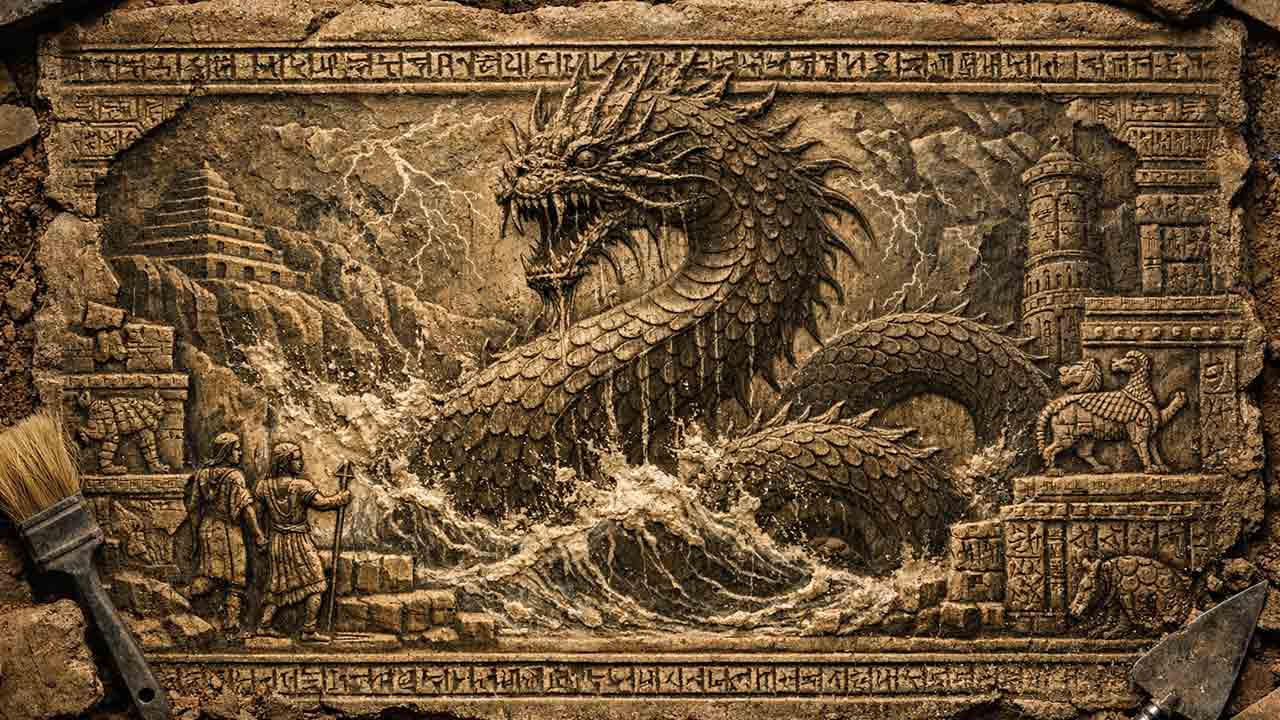
Associated with the primordial sea, serpents, and the birth of the cosmos, Tiamat has endured through millennia as one of the most enigmatic figures in Babylonian mythology — long before modern theories about “reptilians.”
By Aelius Varro
Few figures from antiquity carry an aura as powerful and enigmatic as Tiamat. In Mesopotamian mythology, she was not merely a deity: she was the primordial force of chaos itself, linked to the salt sea, the origin of the gods, and the birth of the universe.
+ The Tablet of the Broken Sky
In the Babylonian tradition, Tiamat appears alongside Apsu, an entity associated with the subterranean fresh waters. Together, the two represent the primordial state of the world, before order, before civilization, and even before the separation between heaven and earth. From their union came the first divine generations, beginning one of the most fascinating narratives of the ancient world.
It is in the Enuma Elish, the Babylonian creation epic, that Tiamat takes on her best-known role. The text describes the conflict between the older gods and the younger ones, in a dispute that grows until it becomes a cosmic war. In this setting, Tiamat ceases to be only the primordial matrix and becomes the great force opposed to the new order of the universe.
In the most dramatic part of the myth, she creates monstrous creatures to confront the younger gods, while Marduk emerges as the warrior destined to defeat her. Marduk’s victory represents not only the triumph of one god over another, but the transformation of chaos into cosmos. In summarized versions of the tradition, Tiamat’s body is used to form the structure of the world, reinforcing the idea that creation itself is born from the destruction of the primordial force.
But after all, how was Tiamat seen? The answer remains shrouded in uncertainty. Different studies and interpretations associate her with water, the serpent, the dragon, and hybrid forms. In some readings, she appears as a monstrous marine entity; in others, as a draconic presence linked to the oldest powers of creation. Her exact image was never entirely fixed, which only deepens the fascination surrounding her figure.
Over time, Tiamat has been drawn into modern reinterpretations that try to connect her to ideas such as reptilian beings and contemporary conspiracies. In the ancient texts, Tiamat was not a “reptilian” in the modern sense of the word, but rather a mythical and cosmic entity linked to the primordial waters, chaos, and the very origin of the universe.
More than a legendary character, Tiamat remains one of the greatest symbols of the Mesopotamian imagination.
She represents the fear of chaos, the mystery of origins, and the idea that all order is born from rupture. Perhaps that is why her story continues to spark curiosity even today among archaeologists, scholars of religion, and readers fascinated by the great mysteries of the past.
