
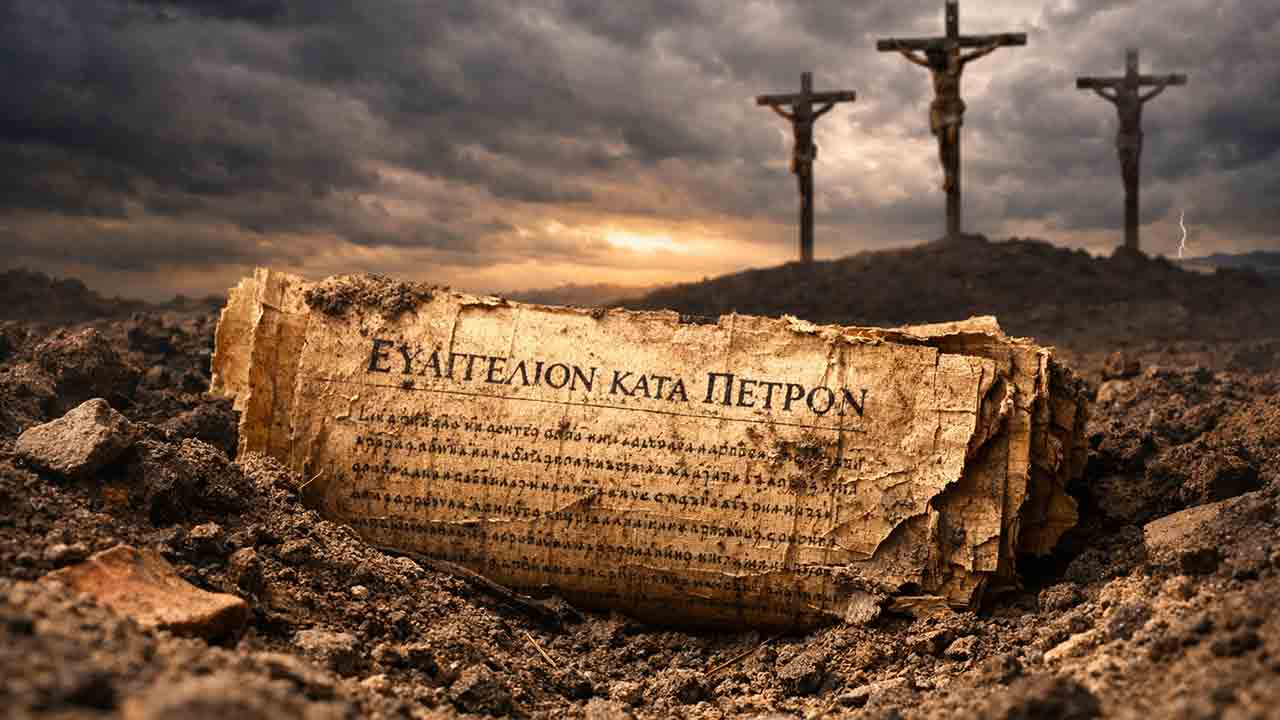
Far beyond the gospels that became part of the Bible, some ancient texts continue to spark curiosity by offering different versions of the final moments of Jesus.
By Aelius Varro
One of the most intriguing is the so-called Gospel of Peter, an apocryphal writing rediscovered in Egypt at the end of the 19th century that still draws attention today for its unusual and almost surreal passages.
+ The alleged biological sisters of Jesus: the forgotten story of Mary and Salome
+ The hidden side of Mesopotamia: the exorcisms practiced by the Akkadians
The manuscript was found in Akhmim, in Upper Egypt, inside the tomb of a Christian monk. Although the archaeological discovery is relatively “recent,” the text itself is much older and is usually associated with the early centuries of Christianity. The preserved fragment does not recount the whole life of Jesus, but instead focuses on the most dramatic episodes: the condemnation, the crucifixion, the burial, and the resurrection.
What makes the Gospel of Peter so fascinating is that it presents details that do not appear in the same way in the canonical gospels. Instead of giving the main emphasis to Pilate, for example, the text places Herod and other Jewish authorities in an even more central role in the condemnation of Jesus. That difference alone is enough to show that this is a distinct tradition from the one that was eventually consolidated in the New Testament.
But it is in the resurrection that the account truly surprises. In the fragment found in Egypt, the scene takes on grand proportions: the sky opens, figures descend to the tomb, and the guards witness the خروج of beings of extraordinary appearance. In one of the passages most discussed by scholars, even the cross appears almost alive, taking part in the episode in a symbolic and striking way.
Another detail that draws attention is found in the words attributed to Jesus on the cross. Instead of the best-known wording from the biblical gospels, the text brings a variant that many researchers see as a sign of a different theology, perhaps linked to ancient Christian currents that interpreted the nature of Christ in another way.
Precisely because it presents these differences, the Gospel of Peter was never accepted as part of the Bible. Christian leaders in the early centuries already showed distrust toward the text, considering that it contained ideas incompatible with the tradition that would become dominant. Even so, the document remained a valuable piece for understanding the diversity of early Christianity.
Today, the Gospel of Peter is seen less as a “hidden truth” and more as a fascinating testimony to how different Christian communities narrated the death and resurrection of Jesus. For modern readers, it remains a window into a past filled with religious disputes, symbolism, and narratives that blend faith, imagination, and power.
