
Long before exorcism became the subject of films and modern legends, the peoples of ancient Mesopotamia were already recording rituals to drive away evil forces.
By Aelius Varro
Among the Akkadians, this type of practice was part of a highly organized religious and therapeutic tradition, preserved in cuneiform tablets that describe incantations, purifications, and ceremonies against invisible evils.
+ The alleged biological sisters of Jesus: the forgotten story of Mary and Salome
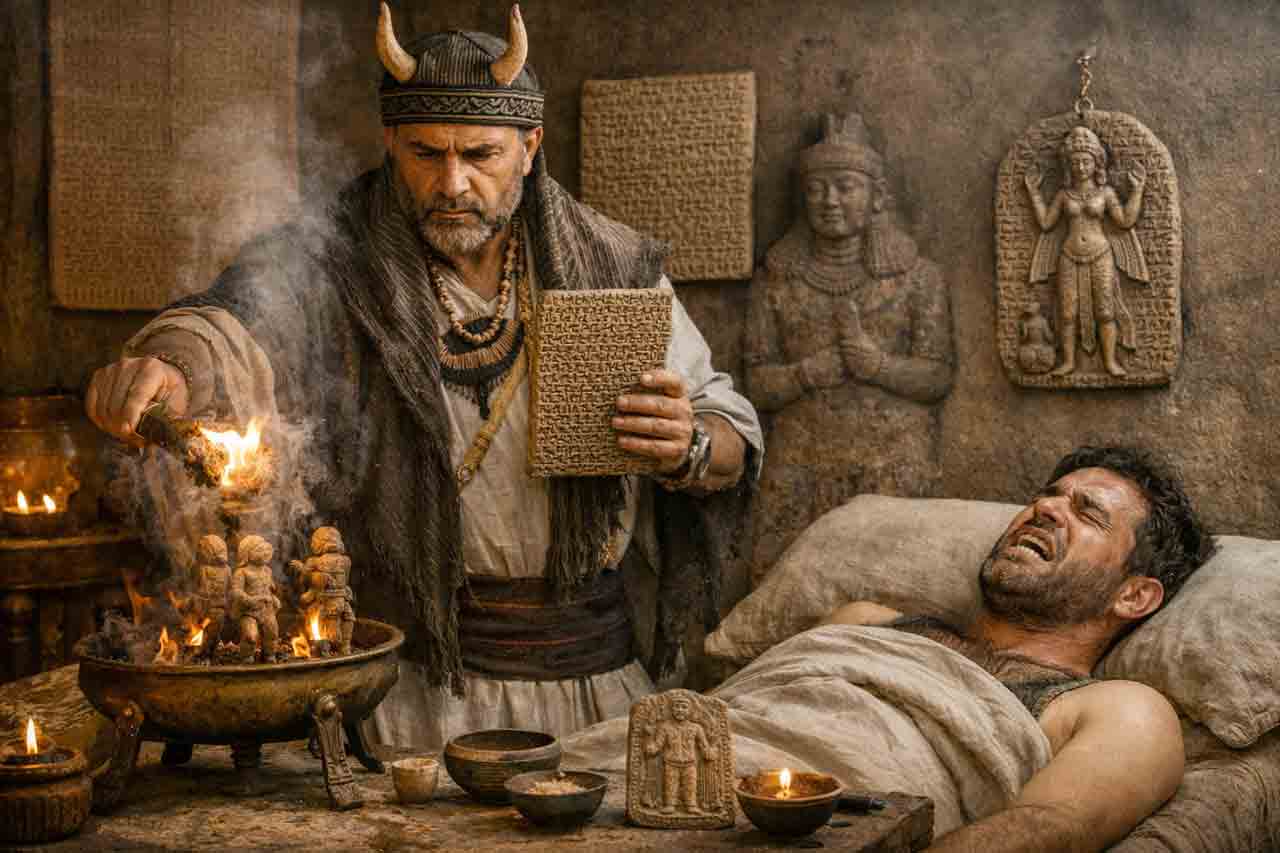
But there is an important detail: for the Akkadians, “exorcism” did not mean only casting a spirit out of a person, as in the modern imagination. The goal could also include driving away demons, neutralizing witchcraft, removing curses, fighting diseases, and even restoring the balance between the sick person and the divine world. The person responsible for this was the āšipu, a kind of scholar-exorcist who worked with purification rituals, spoken formulas, and protective objects.
One of the most striking examples of this tradition is the Maqlû, a major anti-witchcraft ritual from Babylon in the Akkadian language. According to current studies, the ceremony lasted an entire night and included the recitation of nearly a hundred incantations. At certain moments, symbolic figures representing the supposed sorcerers were destroyed by fire, in a ritual gesture meant to return the evil to its author and free the victim.
Another fascinating element was the amulets and apotropaic plaques used as spiritual protection. Among the best known are the amulets linked to Lamaštu, an entity feared for attacking pregnant women, mothers, and newborns. The Metropolitan Museum highlights that these pieces carried inscriptions in Akkadian and divine invocations to exorcise the threat, while the British Museum describes one Lamaštu plaque as a “magic tablet for the sick.”
These objects show that Akkadian exorcism did not rely only on words. There was an entire ritual technology involving images, stones, inscriptions, incense, offerings, and carefully prescribed gestures. In some cases, the ritual was carried out in the patient’s house; in others, in remote places or near water, depending on the deity invoked and the type of evil that one sought to eliminate.
What the ancient texts reveal is that the Akkadians took very seriously the idea that evil could act upon the body, the house, and the fate of people.
Their exorcisms were, at the same time, religion, medicine, and everyday protection. And perhaps that is precisely what makes these tablets so intriguing even today: they show a world in which healing could depend as much on a properly performed ritual as on faith in the power of sacred words.
