
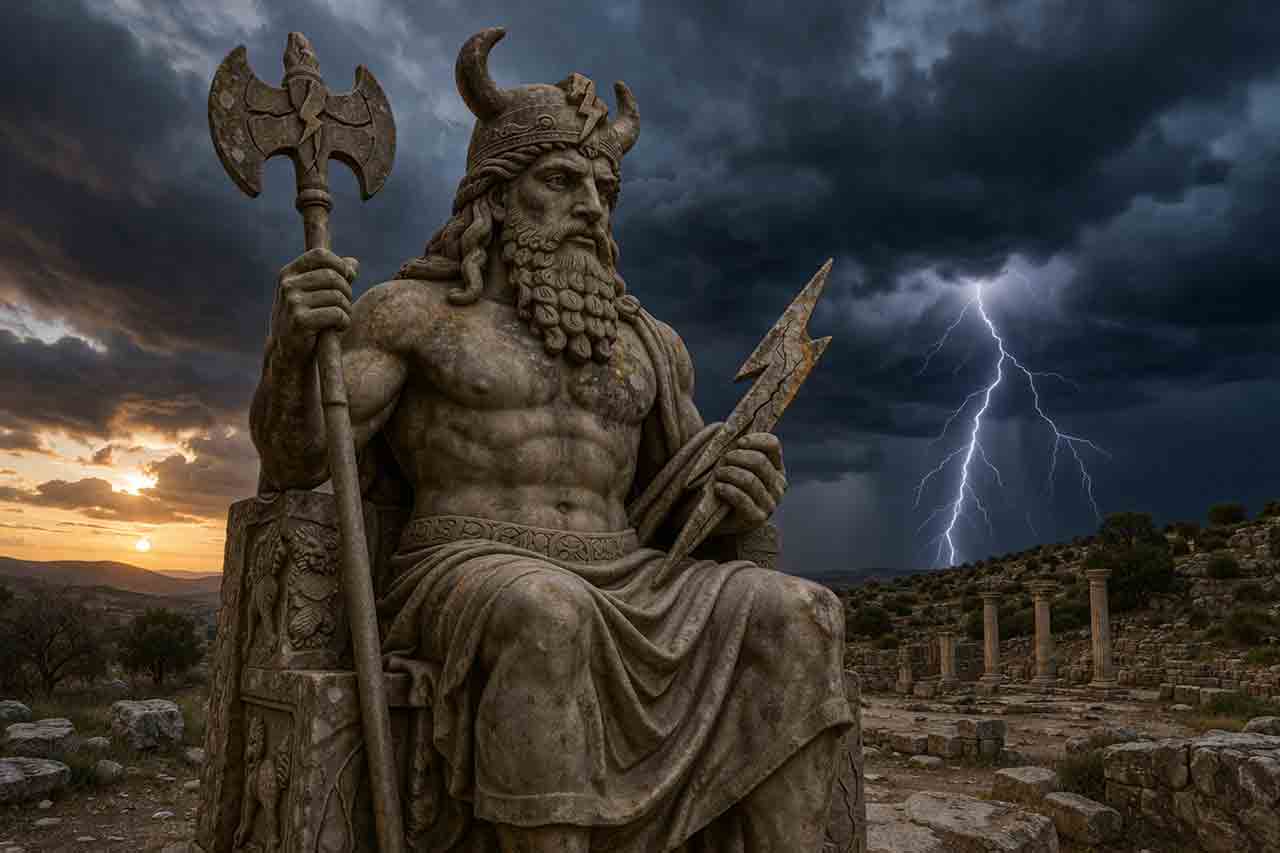
Long before appearing as a rival in biblical traditions, Baal Hadad already ruled storms, fertility, and war in ancient Levantine texts that still intrigue historians today.
By Aelius Varro
Long before his name echoed through the pages of the Bible as a symbol of rival worship, Baal Hadad already held a central place in the religion of the ancient Near East. “Baal” meant “lord,” while Hadad was the Semitic god of storms, thunder, and rain — forces crucial to the survival of agricultural peoples in the Levant. In several regions, he was the main “baal,” the lord par excellence.
+ What Does the Gospel of Peter Say? Manuscript Discovered in Egypt Still Sparks Debate
+ The hidden side of Mesopotamia: the exorcisms practiced by the Akkadians
+ The Tablet of the Broken Sky
The most fascinating part of this story did not first come from the Bible, but from the excavations of Ugarit, an ancient city on the coast of present-day Syria, at Ras Shamra. Its ruins began to be excavated in 1929, and among the discoveries were texts in the Ugaritic language that opened a rare window into the religious universe of the Late Bronze Age. Among them was the famous Baal Cycle, preserved in six clay tablets.
These tablets show Baal Hadad not as an obscure figure, but as a powerful, youthful, and combative god. He confronts Yamm, the personification of the Sea, defeats this adversary with weapons forged by the craftsman-god Kothar, wins the right to have a palace on Mount Sapanu/Zaphon, and then comes into conflict with Mot, Death. The narrative combines divine kingship, cosmic combat, drought, fertility, and the return of life — themes that helped explain the order of the world and the anxieties of a society dependent on rainfall.
It is at this point that Baal Hadad acquires his most mysterious aura. In the Ugaritic texts, he is given titles such as “Rider of the Clouds,” “The Mighty One,” and “Lord of the Earth.” He is the storm god, the one on whom the fields, the harvest, and, in a certain sense, the very stability of human life depend. This portrait is very different from the simplified image that would later become established in later religious readings.
For scholars, the real enigma is not whether Baal Hadad was “hidden,” but how these ancient texts help illuminate the world in which biblical literature itself was taking shape. Academic research suggests that the Ugaritic texts offer literary and religious parallels so strong with the Hebrew Bible that they belong to a shared or overlapping cultural matrix, even without being the same tradition. In other words, when biblical authors wrote about Baal, there was already behind that name a much older and more complex mythological past.
For this reason, the so-called “secret history” of Baal Hadad may be less a conspiracy and more a memory buried by time. Before becoming an antagonist in biblical texts, he was one of the great lords of the stormy sky in the imagination of the ancient Levant — a god who governed thunder, battled the sea, descended into death, and returned as a sign of renewal.
And it is precisely this past before the Bible that makes Baal Hadad one of the most intriguing figures of antiquity.
